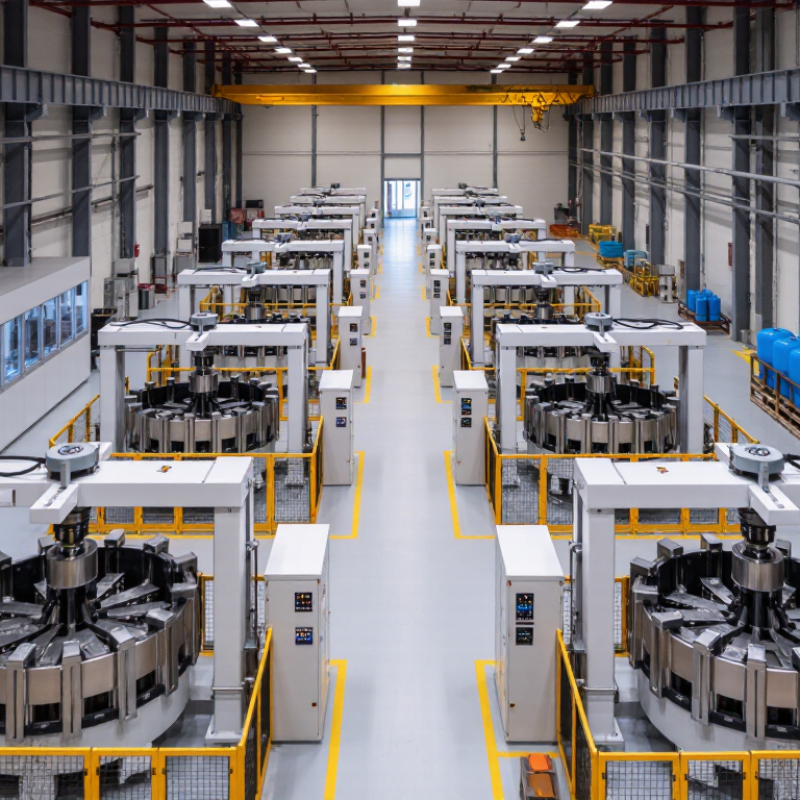
| 1 | Large Shuttle Rotomolding Machine | Oven diameter: approximately 4.5–7.0 m
Typical mold envelope: up to 3.5 × 3.0 × 2.5 m | Approximately 1,500–4,000 kg | 20–60 minutes, depending on part size and resin | Medium to high; recipe control, automatic temperature monitoring and programmable cooling are commonly available | Large tanks, containers, agricultural products, playground equipment and industrial housings | Handles large molds, supports flexible production and allows loading and unloading outside the oven | Requires substantial floor space, high thermal capacity, heavy-duty foundations and suitable material-handling equipment |
| 2 | Medium Shuttle Rotomolding Machine | Oven diameter: approximately 3.0–4.5 m
Typical mold envelope: up to 2.5 × 2.0 × 1.8 m | Approximately 500–1,500 kg | 18–45 minutes | Medium to high; PLC-based recipes and automatic cooling options are typical | Water tanks, waste containers, road barriers, kayaks and medium-sized industrial parts | Good balance of flexibility, production capacity and investment cost | Verify oven clearance, arm reach, maximum mold weight and access for mold changes |
| 3 | Three-Arm Carousel Machine | Oven diameter: approximately 3.0–5.0 m
Typical mold envelope: up to 2.5 × 2.0 × 1.8 m | Approximately 300–1,200 kg | 15–40 minutes | Medium; automated indexing and process recipes are widely used | Repeat production of tanks, bins, pallets, toys and medium-sized hollow components | Efficient use of oven, cooling and loading stations with good repeatability | Arm movement and station timing must match the heating and cooling requirements of each product family |
| 4 | Four-Arm Carousel Machine | Oven diameter: approximately 3.0–5.0 m
Typical mold envelope: up to 2.3 × 1.8 × 1.6 m | Approximately 200–1,000 kg | 12–35 minutes | Medium to high; independent station programming is available on many configurations | High-volume production of smaller tanks, containers, toys and consumer products | High potential throughput because heating, cooling, loading and unloading can occur concurrently | Best suited to stable product schedules; changing between very different mold sizes may reduce efficiency |
| 5 | Independent-Arm Carousel Machine | Oven diameter: approximately 4.0–6.0 m
Typical mold envelope: up to 3.0 × 2.5 × 2.0 m | Approximately 500–2,500 kg | 15–50 minutes | High; each arm can typically use separate speed, temperature and station settings | Mixed-product manufacturing, contract production and plants requiring frequent changeovers | Flexible scheduling and the ability to process different molds or cycle requirements at the same time | Higher capital cost and control-system complexity; operator training and maintenance capability are important |
| 6 | Rock-and-Roll Rotomolding Machine | Oven length: approximately 4–12 m
Designed for long, narrow molds rather than large spherical envelopes | Approximately 300–2,000 kg | 20–60 minutes | Medium; programmable rocking angle, rotation speed and heating profiles are common | Long tanks, pipes, road cones, marine products and other elongated hollow parts | Efficient for long products and can require less rotational travel than a conventional full-axis system | Not ideal for compact, wide or highly complex shapes; mold balance and powder distribution are critical |
| 7 | Clamshell Rotomolding Machine | Oven diameter: approximately 2.0–4.0 m
Typical mold envelope: up to 2.0 × 1.6 × 1.5 m | Approximately 100–800 kg | 15–40 minutes | Medium; fixed or programmable rotation and temperature control are available | Small and medium containers, water tanks, covers, ducts and general-purpose molded parts | Compact layout, straightforward mold access and comparatively simple operation | Check mold-opening clearance, seal design, thermal uniformity and access for maintenance |
| 8 | Swing-Arm Rotomolding Machine | Oven diameter: approximately 2.0–4.0 m
Typical mold envelope: up to 2.2 × 1.8 × 1.6 m | Approximately 150–1,000 kg | 15–45 minutes | Medium; automated arm positioning and process monitoring may be included | Medium-sized industrial parts, bins, tanks, furniture components and specialty products | Good mold accessibility and a practical layout for moderate production volumes | Confirm swing radius, maximum arm load, cooling arrangement and the number of usable stations |
| 9 | Compact Single-Arm Shuttle Machine | Oven diameter: approximately 1.8–3.0 m
Typical mold envelope: up to 1.5 × 1.2 × 1.2 m | Approximately 100–500 kg | 15–40 minutes | Basic to medium; manual loading with programmable heating and cooling is common | Start-up operations, small-batch manufacturing, custom parts and regional production facilities | Lower space requirement, simpler installation and useful flexibility for varied molds | Throughput is limited by a single arm; assess future capacity needs before selecting this configuration |
| 10 | Laboratory and Pilot-Scale Rotomolding Machine | Oven diameter: approximately 0.8–1.8 m
Typical mold envelope: up to 0.8 × 0.6 × 0.6 m | Approximately 5–50 kg | 10–35 minutes | Medium to high; precise speed, temperature and data-recording functions are often available | Material development, mold trials, product research, education and small prototypes | Low material consumption, quick experimentation and easier process development | Limited production capacity; pilot results should be validated on a larger machine before commercial launch |