10 Best Floor Grating Manufacturers for Global Buyers
Choosing a Floor Grating manufacturer is not a simple price comparison. Global buyers need products that perform under real operating conditions. A factory walkway may face oil, rain, forklift traffic, or salt-laden air. Floor Grating must match the application, not merely the drawing. This guide presents ten manufacturers for international buyers. It considers engineering capability, production consistency, material choices, surface treatment, and export experience. These factors create a practical starting point. They are not a guarantee.
A reliable evaluation should examine load ratings, span calculations, mesh dimensions, slip resistance, welding quality, and corrosion protection. Buyers should also verify relevant testing records, quality systems, and product certifications. Clear technical drawings matter. So do accurate quotations. Manufacturing lead time, packaging strength, container loading, and replacement support can affect the final project cost. A neatly bundled panel is useful when it arrives undamaged at a remote construction site.
Details matter most.
No single manufacturer suits every project. A chemical plant may require stainless steel, while a warehouse may prioritize galvanized carbon steel and rapid delivery. Some suppliers offer excellent customization but limited international support. Others provide strong documentation but higher minimum order quantities. This comparison recognizes those trade-offs rather than presenting an artificial winner. Buyers should still request samples, inspect recent project references, and confirm specifications with qualified engineers. Even experienced purchasers can overlook drainage, thermal movement, or local installation practices. That is an honest limitation. A careful shortlist, followed by technical verification, remains safer than relying on marketing claims alone.
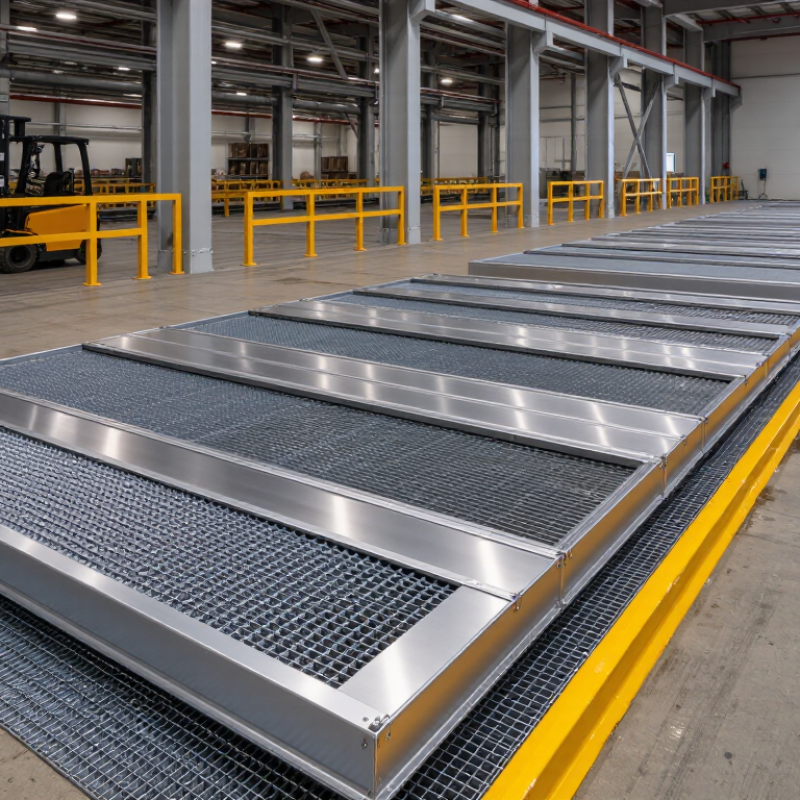
Floor Grating Basics: Types, Materials, and Common Applications
Floor grating is an open platform surface designed for safe access and efficient drainage.
It supports foot traffic while allowing water, mud, and light to pass through. Common types include welded bar, press-locked, riveted, molded fiberglass, and perforated plate grating.
Welded bar grating suits factories and walkways because load bars are joined at every crossing. Press-locked panels provide a cleaner appearance, but damaged crossbars can be harder to repair. That detail matters.
Steel provides high strength for plant floors, loading areas, and heavy maintenance routes. Galvanized steel adds corrosion resistance through a zinc coating, although cut edges still need attention.
Aluminum is lighter and useful where installers frequently lift panels. Stainless steel performs well in wet, hygienic, or chemically demanding spaces, but it costs more.
Fiberglass-reinforced plastic resists many corrosive environments and does not conduct electricity. Material selection should consider load, span, temperature, drainage, and cleaning conditions.
No material is perfect.
Common applications include stair treads, factory platforms, trench covers, ship decks, wastewater facilities, and rooftop service paths.
Before ordering, buyers should verify clear span, bearing direction, panel dimensions, surface finish, and deflection limits.
Anti-slip surfaces help in oily or rainy areas, but aggressive profiles can complicate cleaning. In field reviews, I have seen site measurements differ from drawings.
Measure twice.
A qualified engineer should confirm structural capacity and local safety requirements, especially near openings and elevated platforms.
How the Ten Leading Manufacturers Were Selected
Selecting the ten leading floor grating manufacturers required more than comparing product photographs. We reviewed published specifications, factory capabilities, export experience, and independent quality evidence. The World Steel Association reported global crude steel production of about 1.88 billion tonnes in 2024. This scale shows why material traceability and process control matter for international buyers.
Performance came first. We examined load tables, span guidance, surface treatments, tolerances, and welding procedures. Manufacturers with clear test records received stronger consideration. Relevant evidence included corrosion testing, dimensional inspection, and compliance with recognized standards such as ASTM and ISO requirements. ISO’s 2022 survey recorded more than 1.2 million ISO 9001 certificates worldwide, but certification alone proves little. Buyers still need current certificates, inspection reports, and traceable batch information.
Delivery reliability shaped the final selection. We checked production capacity, packaging methods, port access, response times, and experience with drawings in different measurement systems. A factory may offer strong steel products yet struggle with custom openings or seaworthy packing. That matters. We also compared warranty language and after-sales support, including how defects are documented and corrected. No ranking is flawless. Public information can be incomplete, and some manufacturers disclose less than others. For that reason, the list favors verifiable evidence over promotional claims, while recognizing that local project conditions can change the result.
Product Range, Manufacturing Capacity, and Quality Standards
10 Best Floor Grating Manufacturers for Global Buyers: Product Range, Manufacturing Capacity, and Quality Standards
Global buyers should compare more than price when selecting floor grating manufacturers. Product range matters because plants often need welded, press-locked, swage-locked, stair treads, trench covers, and aluminum options. According to the World Steel Association, global crude steel production reached about 1.89 billion tonnes in 2023. This scale supports broad material access, but it does not prove consistent grating quality. Buyers should request mill certificates, traceability records, and samples from actual production batches.
Manufacturing capacity requires practical verification. Ask about annual output, welding-line automation, galvanizing bath dimensions, cutting accuracy, and typical lead times. A capable factory should explain how it controls panel flatness, bearing-bar spacing, weld strength, and surface treatment. ISO 9001 certification can support process reliability, while ASTM A123 or equivalent standards help assess hot-dip galvanizing performance. For walking surfaces, load ratings and slip resistance should match project conditions, not generic catalog claims.
Small details matter.
In my experience, a factory may show impressive equipment yet provide weak inspection records. That is a warning sign. The strongest candidates publish inspection plans, conduct dimensional checks, and offer test reports from recognized laboratories. Buyers should also review packaging methods, because bent panels and damaged zinc coatings create avoidable site delays. No shortlist is perfect. Capacity figures can change, and certificates may cover only one facility. Reconfirm everything before issuing a purchase order.
Global Buyer Considerations: Certification, Shipping, and Support
When comparing the 10 best floor grating manufacturers for global buyers, certification deserves close attention. A reliable supplier should provide traceable material certificates, clear load tables, and documented welding or fabrication procedures. Ask whether products meet relevant standards, such as EN, ASTM, or local building requirements. The correct standard depends on the installation country and application. Paperwork matters.
Check more than a certificate logo. Request sample inspection reports, coating thickness records, and batch identification on packing lists. Hot-dip galvanized grating may need a stated zinc thickness, especially for coastal or chemical environments. Stainless steel grades should be confirmed through material reports, not informal emails. Small details prevent expensive replacements. Do not guess.
Shipping can change the real purchase cost. Confirm pallet dimensions, container loading plans, gross weight, and export packaging before placing an order. Grating panels can bend when poorly supported, while loose clips may disappear during unloading. A capable manufacturer should explain Incoterms, production lead time, customs documents, and damage-claim procedures. Still, buyers should review these details independently. Even experienced teams miss a clause sometimes.
After-sales support also reveals manufacturing maturity. Look for responsive engineering assistance, installation drawings, spare accessories, and a practical warranty process. Ask who handles urgent questions across time zones. A factory may offer excellent products but weak communication after payment. Request references from comparable projects, while remembering that one successful shipment proves little. Compare evidence, not promises.
| Supplier ID | Primary Production Region | Main Grating Materials | Common Product Standards | Quality and Certification Evidence | Surface and Corrosion Protection | Typical Export Lead Time | Shipping and Packaging Capability | Technical and After-Sales Support | Best-Fit Buyer Profile |
|---|---|---|---|---|---|---|---|---|---|
| Supplier 01 | East Asia | Carbon steel, stainless steel, aluminum | EN ISO 14122-2; ASTM A36; ASTM A1011 | ISO 9001 evidence available | Hot-dip galvanizing; powder coating; mill finish | 25–35 working days | Export pallets, seaworthy crates, container loading plans | Load-data review, shop drawings, installation guidance | Industrial platforms and infrastructure projects |
| Supplier 02 | South Asia | Mild steel, galvanized steel, stainless steel | IS 800; ASTM A123; EN 1090-related fabrication practice | Inspection records available | Hot-dip galvanizing; bituminous coating; painted finish | 30–45 working days | Bundle packing, fumigated timber, consolidated freight | Cutting lists, bolt schedules, replacement-part support | Cost-sensitive commercial and utility buyers |
| Supplier 03 | Western Europe | Carbon steel, stainless steel, fiberglass-reinforced plastic | EN ISO 14122-2; EN 1090; DIN 24537 | ISO 9001 and traceability system | Hot-dip galvanizing; stainless passivation; molded anti-slip surface | 35–50 working days | EU and international pallet standards; export documentation | Compliance review, risk assessment, project documentation | Regulated plants and safety-critical installations |
| Supplier 04 | North America | Carbon steel, aluminum, stainless steel | ANSI/NAAMM MBG 531; ASTM A36; ASTM A123 | Material certificates and mill traceability | Hot-dip galvanizing; aluminum finish; industrial paint systems | 30–40 working days | Domestic and ocean export packing; container optimization | Stamped drawings, application engineering, field support | Energy, mining, and heavy manufacturing facilities |
| Supplier 05 | Southeast Asia | Galvanized steel, stainless steel, FRP grating | ASTM A123; ASTM F3059; EN ISO 14122-2 | Third-party inspection on request | Hot-dip galvanizing; molded gritted FRP; vinyl ester resin | 25–40 working days | Containerized shipments, moisture protection, mixed-load service | Sample approval, color and resin confirmation, remote support | Marine, wastewater, and chemical-processing buyers |
| Supplier 06 | Eastern Europe | Carbon steel, stainless steel, press-locked grating | EN ISO 14122-2; EN 1090; ISO 1461 | Welding and coating inspection records | Hot-dip galvanizing; electro-polishing; powder coating | 30–45 working days | Road, rail, and ocean forwarding options | Detailed fabrication drawings, replacement panels, technical correspondence | European projects requiring dimensional consistency |
| Supplier 07 | Middle East | Carbon steel, galvanized steel, stainless steel | ASTM A36; ASTM A123; EN ISO 14122-2 | Project-specific inspection available | Heavy-duty galvanizing; epoxy paint; anti-slip nosing | 25–40 working days | GCC and overseas delivery; export crates and bundle marking | Fast quotation support, take-off assistance, site coordination | Oil, gas, desalination, and EPC contractors |
| Supplier 08 | Oceania | Steel, aluminum, stainless steel, FRP | AS 1657; AS/NZS 4680; ASTM A123 | Product test reports and coating records | Hot-dip galvanizing; marine-grade aluminum; molded FRP | 35–55 working days | Long-distance ocean freight; corrosion-protected packing | Access-platform design review, compliance documentation | Mining, ports, water treatment, and remote sites |
| Supplier 09 | Latin America | Carbon steel, galvanized steel, stainless steel | ABNT NBR 8800; ASTM A123; EN ISO 14122-2 | Certificate package available by project | Hot-dip galvanizing; zinc-rich primer; industrial paint | 30–50 working days | Regional trucking, ocean freight, export palletization | Spanish and Portuguese technical support; installation guidance | Regional infrastructure and industrial contractors |
| Supplier 10 | East Asia | Press-welded steel, stainless steel, aluminum | EN ISO 14122-2; ASTM A123; ISO 1461 | Dimensional inspection and batch traceability | Hot-dip galvanizing; stainless passivation; anodized aluminum | 20–35 working days | Full-container and less-than-container-load options | CAD files, load tables, prototype production, shipment tracking | OEMs and buyers needing customized panel sizes |
How to Choose the Right Floor Grating Manufacturer for Your Project
Choosing the right floor grating manufacturer starts with the project environment, not the catalogue. Confirm the required load rating, panel span, walking direction, and opening size. A platform carrying forklifts needs different support than a maintenance walkway. Measure twice.
Material selection also requires practical judgment. Galvanized steel suits many industrial areas, while stainless steel may perform better near saltwater or aggressive chemicals. Ask how surface treatment is controlled, including coating thickness, adhesion, and drainage. A reliable manufacturer should provide material certificates, test reports, dimensional drawings, and clear traceability for each production batch.
Inspect the manufacturing process before placing a large order. Review welding quality, bearing-bar alignment, serrated edges, cut accuracy, and frame fit. Request samples when tolerances are critical. Packaging matters too. Poorly protected grating can arrive with bent edges or damaged coatings after a long voyage. Check export packing, labeling, loading methods, and replacement procedures.
Do not choose on price alone. Compare lead times, engineering support, inspection systems, and communication speed. Ask whether the manufacturer can adapt panel dimensions without weakening the design. Independent testing can add confidence, especially for public or heavily loaded facilities. Yet paperwork is not everything. I have seen excellent certificates paired with careless finishing. A factory visit, video inspection, or third-party check may reveal more. The best decision balances verified data with practical evidence from similar projects.
Floor Grating Material Comparison for Global Projects
Material selection affects structural weight, corrosion resistance, service life, and installation requirements. The chart compares representative material densities commonly used in floor grating: carbon steel, stainless steel, aluminum, and fiberglass-reinforced plastic (FRP).

