Top 10 PVC Layflat Hose Suppliers for Global Buyers
Global demand for reliable water transfer equipment is shaped by irrigation, construction, mining, and emergency dewatering. FAO’s The State of Food and Agriculture 2020 reports that agriculture accounts for about 72% of global surface and groundwater withdrawals. That figure does not measure hose demand, but it shows why dependable irrigation equipment matters. A failed connection can interrupt water flow across a field, worksite, or pumping operation.
Pvc Layflat Hose is valued for its flexible construction, compact storage, and ability to move water under pressure. Yet products with similar descriptions can differ in reinforcement, wall thickness, pressure ratings, and resistance to abrasion or sunlight. Details matter. Buyers should compare stated working pressure with burst pressure, confirm diameter and temperature limits, and request test documentation suited to the intended use. A polished catalog is not proof of consistent production.
This guide introduces ten suppliers serving global buyers and offers practical points for comparing their products, manufacturing capabilities, and export support. It draws on supplier-published specifications and established purchasing checks, rather than treating marketing claims as independent verification. No shortlist can replace a sample inspection or a clear technical agreement. That may sound cautious, but it is useful caution. Buyers should also confirm lead times, packaging, customization options, and after-sales communication before placing an order. Industry reports provide useful context; product-level evidence remains essential.
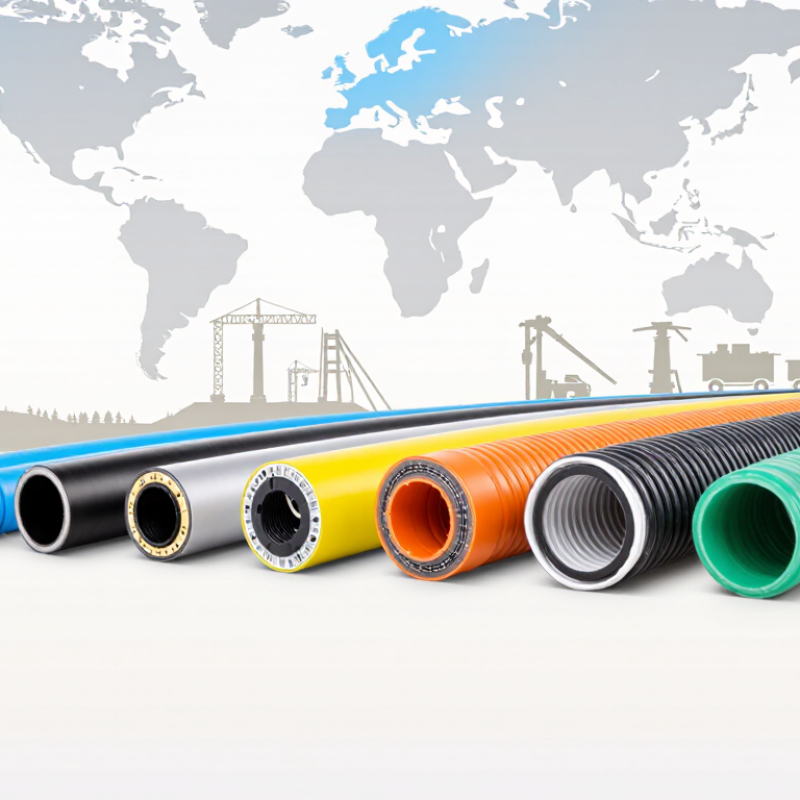
PVC Layflat Hose Market and Global Supplier Landscape
The global PVC layflat hose market is difficult to measure separately because many industry reports group it with broader industrial hose categories. Demand is linked to irrigation, construction, drainage, and temporary water transfer. FAO’s The State of the World’s Land and Water Resources for Food and Agriculture reports that irrigated agriculture uses about 20% of cultivated land but produces roughly 40% of the world’s food. That figure is a useful demand indicator, not a direct forecast for hose sales. Demand is uneven.
The supplier landscape includes manufacturers, trading companies, and regional distributors. Global buyers should compare working pressure, burst pressure, inner diameter, reinforcement, coupling fit, and resistance to sunlight and abrasion. A thick-looking hose is not necessarily a stronger hose; request test documentation and confirm how samples were tested. Shipping terms, production lead time, and spare-coupling availability can matter as much as unit price. Published market estimates often group different hose types, so treat headline growth figures cautiously.
Tip: Ask for a current technical data sheet and a sample from the intended production line. Check dimensions and coupling fit before placing a large order. Also clarify the hose’s operating temperature range; this detail is easy to overlook.
Criteria for Evaluating PVC Layflat Hose Suppliers
A reliable PVC layflat hose supplier should provide more than a catalogue pressure rating. Ask for batch-specific test records covering working, proof, and burst pressure, plus abrasion and UV-resistance results. ISO 7751:2016 defines ratios between design working pressure and proof or burst pressure for rubber and plastic hoses. Check that a supplier’s test method and product scope match the standard. FAO’s World Food and Agriculture Statistical Yearbook 2021 reports that agriculture accounted for about 72% of global freshwater withdrawals in 2018. That figure is not hose-specific, but it highlights why dependable irrigation equipment matters. Small details matter.
Review the hose itself: wall thickness, reinforcement yarn, inner diameter, coupling fit, and flexibility in cold conditions. Request a sample and inspect it under realistic handling; sharp bends, dragging, and repeated pressurization can reveal weaknesses that a brochure will not. Ask how production batches are traced and how defects are handled. A low quote can hide uneven reinforcement or inconsistent fittings. Yet even a careful inspection cannot predict every field condition. This is easy to overlook. Compare documented test results, delivery consistency, warranty terms, and technical support—not claims alone.
Top 10 PVC Layflat Hose Suppliers for Global Buyers
For global buyers, comparing the top 10 PVC layflat hose suppliers means looking beyond price and catalogue photos. A hose may appear suitable yet flatten under pressure or crack after repeated folding. Check its working pressure, burst pressure, inner diameter, wall thickness, and temperature range. Ask whether test results apply to the exact hose construction you plan to order. Details matter.
Supplier communication is part of product evaluation. Request sample lengths, material specifications, inspection records, and clear packaging details before placing a large order. For long-distance shipments, confirm roll length, pallet dimensions, and protection against sharp edges or moisture. Ask how production defects are handled, and whether replacement terms are written down. A polished comparison table can still hide gaps in testing or after-sales support. I would not treat a fast reply as proof of dependable quality.
Match the supplier’s production capacity to your actual schedule, not just your forecast. Confirm that color, reinforcement, fittings, and labeling can remain consistent across repeat orders. Small changes matter. If a sample feels stiffer than expected, ask why; it may reflect a different compound or reinforcement pattern. Buyers should record agreed specifications and inspect incoming rolls against them. Some uncertainty remains, especially when samples and bulk production are made weeks apart.
Product Specifications, Standards, and Customization Options
For global buyers, a hose specification should describe the job, not just the product. Record the inside diameter, operating pressure, hose length, fluid, and expected temperature range. Ask whether pressure ratings apply at a stated temperature and whether burst pressure is tested on finished hose. Reinforcement yarn, wall thickness, and coupling type also affect handling and service life. Small details matter.
Standards are not interchangeable. Request the exact standard and edition a supplier claims to meet, plus relevant test reports or inspection records. Confirm that the documents match the proposed diameter, construction, and production batch. A pressure figure without test conditions is hard to compare. It may look precise, but still leave gaps.
Customization can include cut lengths, colors, identification stripes, printed markings, and fitted couplings. Specify connector dimensions and materials, since a hose that fits one pump may not fit another. For outdoor use, ask about abrasion, UV exposure, and storage conditions. A sample trial on wet or rough ground can reveal issues a datasheet misses. I would not assume a custom option is automatically better; added layers or fittings can increase weight and affect flexibility. Clear drawings and a written approval sample help keep expectations aligned.
International Sourcing, Logistics, and Supplier Support
Global buyers comparing PVC layflat hose suppliers should assess service as carefully as price. Specify inner diameter, working pressure, reinforcement, coupling requirements, and intended fluid. Request recent pressure-test records and batch identification. Details matter. A hose that fits the specification may still arrive with unsuitable couplings or unclear labels.
International logistics can disrupt even well-planned orders. UNCTAD’s Review of Maritime Transport 2024 reports that global maritime trade grew 2.4% in 2023, following a contraction in 2022. That recovery does not guarantee stable freight schedules. Ask suppliers for realistic production lead times, coil dimensions, gross weights, and export-packing photos before booking. Confirm who prepares shipping documents and who responds when cargo is delayed. Small checks help.
Supplier support is most useful when it is specific. Request written guidance on storage, handling, and pressure-test procedures, plus a clear process for reporting defects. Check that quotations identify the hose construction and test conditions; vague wording makes comparisons harder. One sourcing blind spot is assuming every supplier interprets “working pressure” identically. I would verify the stated rating and test basis in writing, then have a local logistics broker confirm destination paperwork requirements.

